If you are a person who believes that risking your life makes you feel alive, then you ought to come to China and cross a busy street during rush hour. Why? Let’s just say that traffic in China is a lot more ‘free-flowing’ than in the states. By free-flowing, I mean that drivers there tend to follow the traffic laws, unless they decide the rules aren’t convenient. If you could stand at an intersection and watch traffic for a while, you would see that red lights usually mean stop, cars usually stay in their lanes and bikes and motorcycles usually go in the same direction as the rest of the traffic. However, you would also see that at certain times during the day, many of the rules are thrown out the window and chaos reigns. Check out the video to see what I mean.
Despedidos (Farewells)
This post I dedicate to all my new friends, especially my Spanish friends—Silvia, Daniel, Luis, Susana and Konstantina (not quite Spanish, but close enough), os echo de menos.

One of the most difficult parts of coming to a place like BLCU for a month is that time goes by so quickly, and just when you are beginning to make good friends, you have to say farewell and go back to your own countries. At the end of each of the last several days, I have had to say goodbye to lots of new friends, wondering each time if it would be the last time I ever saw them. We always hope to meet again, but the truth is that you never know, so you wish each other the best in life, wherever it may take you.
Living Behind the Great Firewall
One of the things that US media frequently mentions is the issue of internet censorship in China. This year, Google got into a row with the Chinese government over Google’s refusal block some of the search results that the Chinese government deems too sensitive for the general public (things got so bad at one point that Google announced it was pulling out of China completely. The company and the government have since reached some type of agreement, though I expect the tensions to arise again in the future).
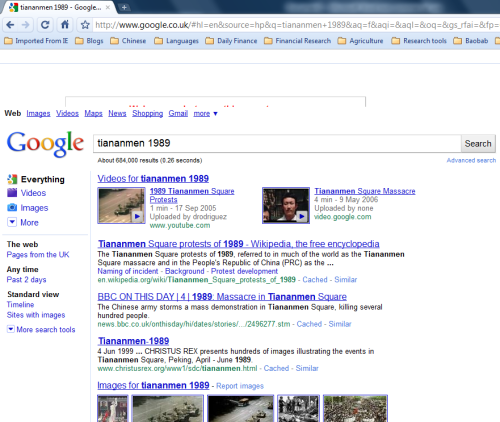
If you search for Tiananmen square, for example, you get lots of search results about the square’s history, design, annual visitors, etc. However, if you add 1989 to the search, you get a message that Google is not available. If you try to go back to the search page, you get the same message and will have to wait a few minutes for Google’s services to return. On Bing, Microsoft’s search engine, you can search for Tiananmen 1989, but if you click on any result that has ‘protests’ or ‘massacre’ in the description, you get nowhere.

Who are You? Names in China
If you ever decide to study Chinese, as a foreigner one of the first things the teacher will do is help you select a Chinese name. It is tradition that everyone who studies the language has a Chinese name. Students also learn to write their name in characters (hanzi), and the name will stick with you for as long as you study Chinese. I suppose it’s possible to change it, but I don’t know many people who have.
You might find it interesting to know how the teachers come up with the names. There are two parts to the name, and the family name is written first, unlike in most countries in the West. Some students, from Korea and Japan in particular, already have names that can be written in traditional Chinese characters. The pronunciation is different, but the meaning is the same. Park Junwoo becomes Piao Junyou, for example. For people from other countries, the teacher often takes the first couple letters of each of your first and last names and tries to find names that sound similar to those syllables and also have a nice meaning. For example, Jennie Griffen becomes Zhen Gui, which sounds like Jenny and means ‘really honorable.’
Chinglish of the Day
Two more interesting translations. I know some people who would like to have "infiniti" hair (I think).