Caffè Umbria

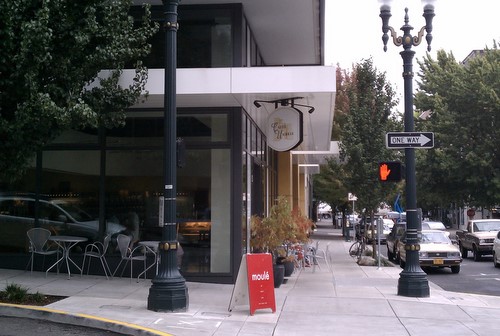
With its high ceilings, large windows, hardwood trim and modern chairs, Caffè Umbria fits in well in the heart of Portland’s Pearl District. The modern coffee bar, decked out in brushed stainless steel, contrasts with the antique pottery sitting on top of it. These elements, modern and antique, combine to give the café an new-world feel with just a bit of the old.

At the corner of 12th and Everett

Caffè Umbria is a Seattle-based coffee company that has “invaded” the Portland coffee scene.

Read More

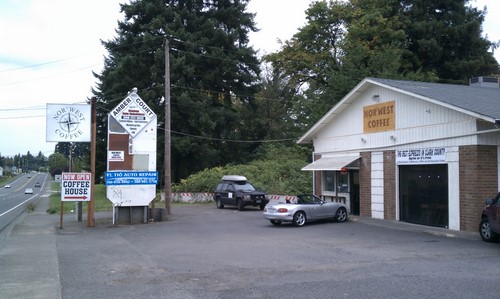
Nor'West Coffee

My quest to find good coffee took me outside the city limits the other day. I traveled up the I-5 corridor from a city who’s catchphrase is “Keep Portland weird!” to a city that likes to say “Keep Vancouver normal.” While the cultures of the two cities are very different, one thing they share (besides the rain) is good coffee. Before any Portlanders reading this get upset, I want to make it clear that I’m not implying the two are coffee equals. So far, Portland has a clear lead. In fact, until the other day I didn’t even know that Vancouver was competitive.

However, yesterday a friend of mine from Vancouver, Tim Downing, introduced me to Nor’West Coffee and I found that there are a few coffee experts in the state to our north as well. Nor’West is a café that has been around for nearly three years. After roasting his own coffee for about seven years, Mike McGinness, the owner, began roasting commercially three years ago under the name Compass Coffee. The company has three retail outlets—one in downtown Vancouver (Compass Coffee), one in North Vancouver (Nor’West) and one in Beaverton (Java Nation) that it acquired three months ago.

Nor'West Coffee

Read More

China’s National Day

It has been a while since I talked about China, so today is a good day to return to the subject. October 1st is a very important day on the Chinese calendar. It is the day that China celebrates the founding of the People’s Republic of China, which happened in 1949 in a ceremony at Tiananmen Square.

Schools close for a week and many people travel to their hometowns to visit family and celebrate together. The Chinese government celebrates the day by organizing fireworks displays and other festivities, including turning Tiananmen Square into a huge flower garden (I hope the video loads more quickly for you than it did for me). This year China also launched a satellite to the moon on the same day. China wants to send astronauts to the moon and this mission was to test some of the technologies for that.

This year’s events did not receive the attention that last year’s did. Last year was the 60th anniversary of the founding of the republic, and the government put on a huge military parade on Changan Lu (Long Peace Road, ironically), showing off all of the new military hardware that China has developed in-country. It was a display of strength that made a great story for western media outlets looking to portray China’s military as a growing threat. Some, however, argued it also displayed weakness, since the Chinese government did not let Beijing residents anywhere near the parade, lest they disrupt the carefully-planned event. Whichever side you agree with, the scenes of tanks, trucks, armored personnel vehicles and thousands of soldiers passing in formation past Tiananmen Gate under the approving eyes of President Hu Jintao were striking. 

Take to the Road

I finished reading a book today called The Songlines. Written by Bruce Chatwin, it describes his trip to Australia to learn about the Aboriginal cultures of the continent. The work, a mixture of travel memoir, fiction and philosophy, is based on an actual trip he took a couple years before his death in 1989. It details Chatwin's travels on the continent as he tries to understand the “songlines.”

The songlines are the fundamental element of the Aboriginal creation stories. At the beginning of time, the “Dreamtime”, the Ancestors created themselves out of clay and began to wander across the earth, singing out the names of everything they saw—animals, plants, rocks and streams—thus defining their existence.

The paths that the Ancestors traveled on as they sang are known as songlines (or dream-tracks), and the songs are passed down from generation to generation. When an aboriginal goes ‘walkabout’, he follows the original songline that his ancestors did. The songs are always sung in exactly the same way, as a way of maintaining the creation. If a wanderer remembers his song and does not deviate from its path, he can never get lost. The melodies along each line are constant from one end of the continent to the other. They are transferred across boundaries where one clan’s territory ends and another’s begins. The melody stays the same, even as the words would change. In addition to maintaining the creation, the songlines also act as trading routes among the clans.
Read More