To the woman who offered to bus my table today because you saw that I had two squirming children with me, thank you. You probably will not read this, but in case you do, I want you to know that you are appreciated. You brightened my day.
Coffee Snobbery?
Today in the Oregonian’s A&E section, there was an article titled “Non-Foodie's Food Guide.” The article had a tone that mocked Portland’s “foodies,” people who have a reputation for eating only local, organic foods at non-chain restaurants. The article implied that foodies don’t go to the same places where ‘normal’ eaters go.
In addition to food, the article talks about coffee too, comparing some of the more well-known Portland roasters (like Stumptown) to Dutch Bros Coffee, a Grants Pass-based chain. The author implies that Dutch Bros. comparable coffee and more friendly service than Stumptown. One of the Dutch Bros. franchise owners is quoted as saying “We’re trying to be a blue-collar stop. We call our big coffee a ‘large.’” (That quote reminded me of my time working at Starbucks. Once in a while, people would come into Starbucks and tell me they wanted a medium coffee but they didn’t “know how to say grande, or whatever you say here.” I used to smile and explain that I understood English too.)
The piece has received a lot of attention and comments from readers today. On one side, there are people that say “That’s right! Foodies are rich snobs who eat overpriced food and drink overrated coffee!” and there are others that say “Why would anyone go to the chains? Their stuff is garbage!” The third type of comments are those that ask “Who cares? Most of us like to go wherever we can get good food and drink at prices we can afford, and by writing this article the Oregonian is just trying to create conflict where there really is none.” I agree with the third type of comments.
However, I can imagine some of you thinking when I write about a coffee’s fruit notes and smooth finishes, it seems pretty ridiculous. In some ways I agree, but it’s not that bad if you think about coffee like if it were music. I’ll try to explain what I mean:
What Makes a Good Café
Some of you have probably noticed that I mostly write favorable reviews for cafés. That’s true, I do. I try to find as many redeeming qualities in a café that I can. I’m not interested in making a cafe look bad. If there’s a place I really don’t like, I don’t bother writing about it. I’m not out to make enemies and I’d rather use my time to write about places that I think are worth visiting.
So what makes something a good café? Here’s a list of things that I look for, so that you can have an idea of my criteria.
- I tend to like places that give a damn about coffee and about service. If a place cares about both, it’s likely to get a good review.
- I like places with personality. The café doesn’t have to be weird, but having something that distinguishes it from other cafés is a good thing.
- I drink my coffee from a ceramic cup. If a café only has paper cups, it ought not be in business. Not only is it wasteful to use only paper cups, but I also hate putting paper in my mouth. I’ll do it if there’s no other option, but it doesn’t make me happy.
- On a similar note, any self-respecting café ought to have metal stirring spoons. If you only have plastic stirrers, or even worse, only wooden stirring sticks, you lose major points. A wooden stick transfers its flavors to the coffee, and how am I supposed to clean up the sugar at the bottom of my cup? The only time I want to put wood in my mouth is when I’m using a toothpick to clean steak out of my teeth.
- Music volume is important. I like music. I listen to music. I write music. I play music. When I’m in a café if you want to play music, that’s great. However, if it is so loud that I can’t have a conversation or if I can hear your music over the music coming through my earphones, you ought to turn your music down.
- Friendly service makes me happy. I don’t expect you to be super-smiley, but polite and friendly is not too much to ask.
- If I come in to a café and you don’t want to pause your conversation with a co-worker to help me, that’s a bad sign. I promise not to be on my cell phone when I order, and you should offer me similar respect. If you don’t, you’re not getting a tip and you’ll probably lose a customer.
- Show some enthusiasm for the coffee, for crying out loud!
- I tend to prefer places that have just a touch of class. I’m not expecting high society, but I prefer things to look neat. It’s a bonus when the baristas dress similarly as if they were all part of a team.
- Your employees ought to know something about the coffee. I don’t expect everyone to be coffee experts, but if you ask an employee “What’s your coffee like?” and he or she says “Um, it’s good," you are losing an opportunity to educate me and create more interest in your coffee.
- Wi-Fi is nice to have. It’s not a requirement, but as a writer it’s one of the tools I like to have available.
- Finally, there’s the most ambiguous criterion of all: vibe. Some cafés have it, some just don’t. I don’t know how to explain this one. It’s like trying to explain what “cool” is. Fonzie was cool, Richie wasn’t. Same goes for cafés.
That’s what I look for when I go to a café. Anyone care to add anything? One of these day’s I’ll write up what makes a good customer. We have a few responsibilities too.
World Cup Coffee and Tea
After checking out the Sterling kiosk on Glisan, I decided to head toward downtown to find a place to sit and write. I didn’t make it very far. A few blocks down Glisan, I came across World Cup Coffee and Tea. I had been planning to try World Cup coffee, but I thought I would go to their café in Powell’s Books. However, since the opportunity presented itself, I decided to stop and check this one out. It turns out that the store on Glisan is World Cup’s headquarters and main café. The company has its offices and its roasting operation there.
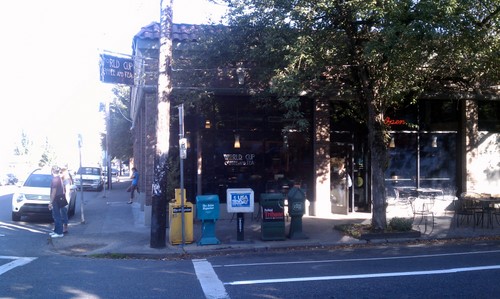 World Cup from the outside
While waiting in line, I read some of the company’s literature and I thought I was at another café for coffee enthusiasts. Having visited many similar places, I expected the people in the café to be knowledgeable about the coffee. I walked up to the counter and asked the barista what their espresso was like. She paused for a second.
“It’s really strong. Have you had espresso before?”
Sterling’s Kiosk
I intended to give Coffeehouse Northwest a review the other day, but when I arrived and asked what espressos they had available, the barista informed me that they only had Hair Bender (from Stumptown) available. Actually, they had two different Hair Benders available, each with a different roasting date. While it might have been an interesting exercise to compare how the roasting dates affected the flavors, I was hoping to try something different. The barista suggested I go to Sterling, a few blocks away on NW Glisan. She said it doesn’t have any tables, but that if I wanted to I could bring my drink back from Sterling and sit down at the café and hang out. Though it was a nice offer, I decided to come back to Coffeehouse Northwest another day.
It took me about five minutes to walk over to Sterling, and when I arrived, I found what appeared to be an old-fashioned coffee bar, built in the style of the 1920s (at least that was my impression). The kiosk was sandwiched into a small space by the entrance to a flower shop.
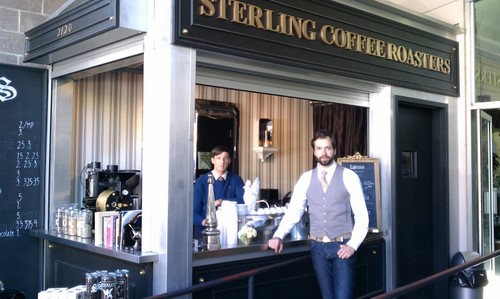 Small but classy (dressing up is optional)
Tim, the barista, greeted me and I asked him about their espresso. He recommended that I try the Ethiopian Yirgacheffe (YUR-guh-chef) coffee. It was a little more expensive than the house blend they had available ($2.50 for a double), but it was more interesting too. He described the espresso as beginning with blackberry flavors, continuing with a smooth middle and creamy finish that was like Baileys (Irish cream). That sounded interesting enough for me, so I ordered one and watched him prepare the espresso.