The Magic of the Vacuum Pot (My $9 Cup of Coffee)

When you read what I did yesterday, you might want to ask me: Are you f---ing nuts? Believe me, I asked myself that question more than once. What did I do? I’m almost ashamed to admit it, but I spent $9 on a cup of coffee (12oz). No, that’s not a misprint. I promised a reader (Jake) that I would write about the vacuum pot, or siphon method of brewing coffee. I knew that Barista in the Pearl District had them, so I went there on a mission—seek out a vacuum pot and report on its mysterious powers. Then I got there and saw the price. It almost made me cry, but I had made a promise. . .

What is so special about the siphon brewing method? Well, for one thing, it’s great coffee theater.  A vacuum pot looks cool—almost space-aged, even though it has been around for nearly 150 years! You don’t see them in use very much, so when you do get to see one it is worth watching. I stood there captivated as the barista prepared my precious coffee, an Ethiopia Sidama from Intelligentsia.

This is how the siphon method works: First, the barista measures out the correct amount of water into the lower bulb of the vacuum pot. The bulb is then placed over a heat source. It could be a flame or a hot plate, but at Barista, they have specially-designed heat lamps that heat the water (it looks cooler that way). While the water is heating, the barista then measures out and grinds the proper amount of coffee, setting it aside until the water is ready.
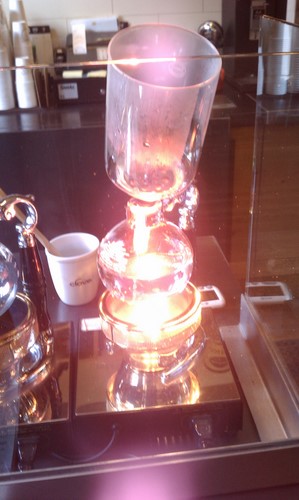
Warming up

When the water begins to boil, steam travels up a tube, condensing back into water as it travels upward. When it reaches the bowl on top, the water is about 202 F, just the right temperature for coffee extraction. When nearly all the water has reached the bowl, the barista adds the ground coffee and stirs it, making sure that the all of the grounds are in contact with the water. While the extraction is taking place, the small amount of water in the bottom bulb continues to rise into the extraction chamber, helping maintain a constant temperature. The coffee is allowed to brew for two to four minutes, depending on the grind.
Read More

A Taste of Seattle

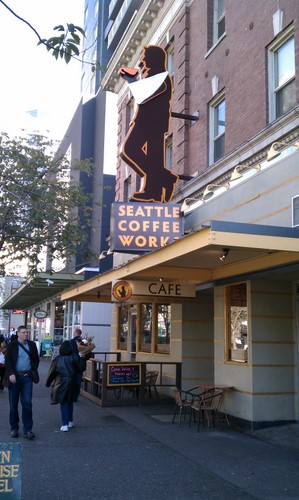
I was able to sneak out of Coffee Fest last weekend for a few minutes to check out a couple Seattle coffee shops. My first stop was Seattle Coffee Works. Located near Pike Place Market and across the street from the first Starbucks café, Seattle Coffee Works catches your eye with its distinctive sign outside and then it catches your taste buds with its interesting coffees. The café has an espresso bar and a “Slow Bar” for those who are interested in a pour-over or vacuum pot of coffee. A blend of Brazilian and Indonesian beans were “on grind”  along with a direct trade single-origin Guatemala (or El Salvador?).

Seattle Coffee Works

My second stop was Stella (not to be confused with Spella in Portland). I had been told that Stella has a 100% Robusta espresso blend that is the best in the city. Unfortunately, I went there about 5pm and—take note other late-afternoon coffee drinkers—Stella closes down its espresso bar at 4pm. The barista told me to come back Saturday after 10am.

Read More

Coffee Fest Recap Part 2

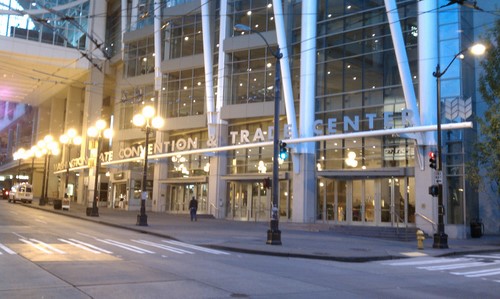
In addition to the exhibitions, Coffee Fest also offered several free classes (and some paid ones) to help people improve their businesses and increase their coffee knowledge. Because I am one of those people who liked school, and because they were free, I decided to attend the Saturday morning classes. I had to get up at 6:15 to get there on time Fortunately, it was a beautiful clear, crisp morning and the walk to the bus stop was invigorating. The bus from Everett dropped me off a block from the convention center about twenty minutes before my first class started (Side note: Seattle’s public transportation, although primarily buses, is better than its reputation).

The street lights were still on when I got to the convention center

My first class, “How to Effectively Compete with National brands,” was taught by Sol Salzer, one of the owners of the City Bean Coffee in Los Angeles. The first thing he did was to thank Starbucks and the other national chains (Peet’s, Gloria Jean’s, Coffee Bean, etc.) for raising the standards of the coffee industry. Then he spent the next hour talking about how to beat them. He used Starbucks as his main example, telling the story of how he used the Starbucks that moved in across the street to help grow his business. Starbucks brought many customers to the neighborhood, and City Bean was able to capture some of that traffic by effectively targeting them.

Read More

Coffee Fest Recap Part 1

If you’ve read my last couple posts, you know that I spent this past weekend at Coffee Fest in Seattle. One of the reasons I wanted to go to the show was to see the city itself. It had been a long time (8 years or so) since I visited the Emerald City, and I had forgotten how much bigger Seattle is. Seattle’s downtown area has a lot more people and quite a bit more traffic.

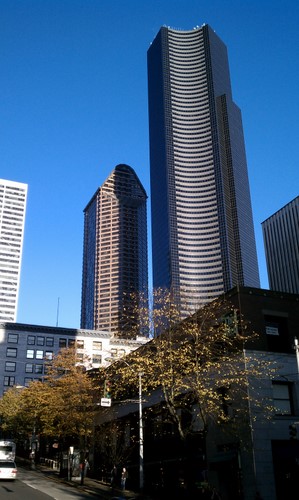
Like Portland, Seattle has a reputation for being rainy, but when the sun is out (as it was on Friday afternoon), it is a beautiful city. On a clear day you can see the Olympic Mountains to the West and Mount Rainier to the East. Located on Puget Sound, Seattle has a number of inlets and lakes that carve up the city.

Nothing but blue sky, at least for one day

Read More