In an era when it is trendy to be “green,” there are a lot of companies that like to promote their environmental credentials. If you walk down the aisles at the supermarket, you can see hundreds of products lining the shelf that are “natural,” “green,” or “earth-friendly.” Companies know that they are expected to care about the environment. They create CSR (corporate social responsibility) departments and cobble together a few initiatives to make themselves appear more earth-friendly. Sometimes the claims are exaggerated or misleading (can you tell me exactly what “natural” means?), and sometimes the initiatives are meant to overshadow other, less environmentally friendly parts of the company (BP becoming “Beyond Petroleum,” for example). In these cases, there is nothing like a good “greenwashing” to clean up the company’s image.
Not all companies are just paying lip service to being green, however, and it is encouraging when you come across a company that strives to live up to its environmental claims. Portland Roasting Coffee is a company that backs up its green talk with actions.
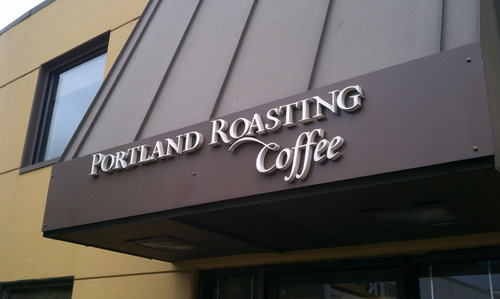
I recently sat down with Mark Stell, Portland Roasting’s co-founder and managing partner, to talk coffee. Stell told me the story of how he got into the coffee business and also about the some of the projects that Portland Roasting is working on.
The first time I heard Stell speak was when he visited our sustainability class for the MIM program at Portland State University (PSU). One of the topics of that class was the triple bottom line, where companies strive to make a profit while including social and environmental criteria in their accounting of success.
Stell told us how his company was using the triple bottom to drive company decisions. He described some of Portland Roasting’s development projects such as building wells and other water projects in the communities where the company sources its coffees. He admitted that sometimes his company should focus more on the economics, but was firm in his belief that environmental and social consequences were just as important.
Inspired to Action
We met in a conference room at Portland Roasting’s Inner Southeast Portland headquarters. Stell began by telling me about his introduction into the coffee industry.
Originally from Wisconsin, he was studying marketing at PSU when he had a life-changing experience at the United Nation’s Earth Summit in Rio de Janeiro in 1992.
“I was in Rio in ’92 as a student delegate for Portland State,” he said. “While we were there, all of these speakers kept coming up to the stage and telling us how their lives were being affected by global warming. It was a powerful moment. You never want to forget how you feel at times like those.”
Attending the summit was a watershed moment in Stell’s life, and he decided to act based on his new awareness of problems including poverty and global warming. When he got back to Portland, Stell looked for a job with a local coffee roaster. He chose to work in coffee for a very specific reason.
“Coffee is an industry where you can really make a difference. It is unique in that it is so far-reaching. There are millions of people involved in its production, and it also covers issues like poverty and equity between developed and developing countries.”
At the time, he did not even like coffee, though his distaste for the beverage did not last long.
“After six months I was completely hooked. I loved it,” he said.
After a short stint at the local roaster, Stell decided it was time to move on. He and his business partner, Todd Plummer, started Abruzzi Caffè, a roastery/café in Northwest Portland. After a couple years, they sold the business and started Portland Roasting.
Since its founding in 1996, Portland Roasting has grown by leaps and bounds. Today, the company roasts about 900,000 pounds of coffee each year. Much of its coffee is sold in cafés, supermarkets, hotels and universities. Portland Roasting also sells a substantial amount in Japan.
Portland Roasting recently announced that it would be opening its own retail cafés in the Oregon Convention Center, just a few blocks away from PRC headquarters. The company will have two cafés in the building, giving the company an opportunity to showcase its products and mission. The first one is set to open in August.
Leading in Sustainability
One of Portland Roasting’s accomplishments that Stell is most proud of is receiving the SCAA (Specialty Coffee Association of America) Sustainability Award in 2005 for the company’s Farm-Friendly Direct Program. In the program, Portland Roasting pays above-market prices for the coffee and the premiums are used for community projects such as building schools or water purification facilities in the communities where coffee is grown.
In addition to investing in communities abroad, Portland Roasting has also undertaken several sustainability initiatives closer to home. These include implementing recycling programs, contracting with B-Line (a bicycle delivery service) to deliver its coffees, using biodiesel-powered vehicles, purchasing wind-generated electricity and contracting with Trees for the Future to plant trees to offset the company’s carbon dioxide emissions.
One of the biggest initiatives that employees undertake each year is putting together annual Walk for Water. The three-year-old event is overseen by Portland Global Initiatives, a non-profit that Stell founded to raise money for water-related projects in Sub-Saharan Africa. Portland Roasting works in conjunction with a capstone class at PSU to organize and promote the event, which in 2011 raised more than $30,000.
Coffee Economics
In addition to the sustainability issues, Stell also keeps a close eye on Portland Roasting’s financial position. We talked about how the recent run-up in prices has affected the company.
“It’s been tough,” he told me. “We’ve had to raise our prices three times in the last year. I know it’s been hard on our customers.”
PRC’s long-standing relationships with its growers has helped the company weather the recent price increases.
“I tell [our customers] that it could be even higher if we didn’t have these relationships. Some of our growers have been helping us out, charging lower prices than they could have, because we have been good to them over the years. Most of our growers stayed with us. There was one group who decided they had to go for the money. You hope for loyalty in return for working with someone for a while, but it doesn’t always work out. It’s sad to see that happen, but I understand why it did.”
Stell sees quite a bit of uncertainty in the future of coffee prices.
“There’s going to be a lot more competition for high-quality beans. I see that as being a major challenge. As China comes into the market, it could become harder and harder to get the best beans, so there might be more of a price differentiation between coffees, much like there is between wines. I hope that coffee still remains a beverage that everyone can afford. We’ll see what happens.”
START-ing a New Movement
In addition to his duties at Portland Roasting, Stell also sits on the SCAA’s sustainability council. He helped spearhead the effort to create the recently-released START (Sustainability Tracking and Reporting Tool) application, an online program that helps companies monitor their environmental impact.
The START project, which has taken six years to complete, was undertaken with the United Nations’ Millennium Development goals in mind. The SCAA still needs to raise a few thousand dollars to finish paying for the program’s development, but once enough companies sign up, the program will be self-sustaining.
There are several goals for START. One is to make it affordable for companies to monitor their social and environmental impacts so that they can improve them. Normally, software to do this would cost a company tens of thousands of dollars, but START is available for $150/year to participants in the program.
Another goal is to help the entire coffee industry understand its overall impact. The data that the program collects will be compiled, allowing the SCAA to release it to the public (without releasing individual companies’ data). The data will help companies see where they are in relation to industry benchmarks.
One of START’s key benefits is that it provides a forum for sharing information about development projects. The plan is for START to help companies interested in development projects to collaborate with each other. For example, if a project is too large for a single roaster to undertake, the project can be posted to START.
In addition, Stell said, START helps coffee-growing communities share their needs.
“If I’m in a community that needs help building a school, I can post it on the site so that companies that are looking for projects can work together. It’s creating a community for development.”
START also includes a certification system for companies participating in the program. To receive the certification, companies must add a certain amount of data to the START system, demonstrating that they are closely monitoring their carbon footprint and social impact. The SCAA hopes that consumers will gravitate towards companies with this certification, much like they do with Fair Trade.
More Than Hot Air
As a company, it is much easier to talk about being green than it is to actually do it. Many companies try to make you believe that they are working to help the environment, putting in as little effort as they can to build their green image. Portland Roasting Coffee, on the other hand, led by its passionate founder Mark Stell, is leading the coffee industry toward a more sustainable future, something that is not just a bunch of “greenwash.”


