I recently met with Jim Roberts, owner of Jim & Patty’s Coffee on Northeast Fremont, to hear the story of his friendly neighborhood café and its quirky sense of humor. I also wanted to learn about the history of Coffee People, a Portland coffee company founded by Roberts and his wife Patty. Coffee People, like Stumptown today, was once the beloved local brand trying to expand nationally. During our interview, Roberts shared the long history of Coffee People, and also gave me some insight into some of the challenges associated with trying to grow a company into a national brand.
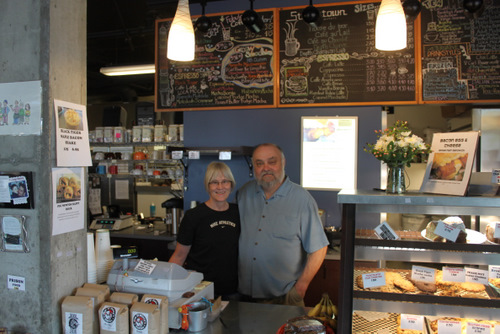 Jim and Patty Roberts
Starting out in the ‘70s
Sitting down to talk with Jim Roberts, you get the sense you are talking with someone who has seen just about everything during his time in business, someone who has had successes and failures but who has also managed to keep things in perspective.
The Roberts, who have been married for 41 years, started out selling coffee in Eugene in 1973. At the time, Jim was attending the University of Oregon, and in order to raise money for school, they began to sell coffee at Eugene’s Saturday Market.
In those days, the Roberts bought their coffee from a little company called Coffee Bean Coffee Company, also located in Eugene. Jeff Ferguson, who Jim called the “coffee pioneer of Oregon,” founded the small coffee roaster.
“When Jeff started, he had a little counter, 150 square feet and a roaster. He stood behind the counter and sold his coffee out of a jar. I loved the coffee, so it was what we bought and sold at Saturday Market.”
Over the years, Coffee Bean ended up becoming the huge Portland roaster known as Coffee Bean International (CBI). At the time, though, Coffee Bean Coffee was just a small company struggling to survive. It expanded from Eugene into the Portland market, but in 1976, the company went through bankruptcy.
Seeing an opportunity, Jim and Patty bought Coffee Bean’s Portland store, moved to Portland and changed the name of the store from Coffee Bean to Coffee Man. They picked the new name mostly for economic reasons.
“The B-E was easy to change into an M and wouldn’t cost us much, so we called it Coffee Man.”
The birth of Coffee People
The couple eventually sold Coffee Man to a relative and moved to the Oregon Coast. After a few years of roasting coffee there the Roberts moved back to Portland in 1983 and started a new café in Portland called Coffee People. Over the next decade and a half, Coffee People would take them on a roller coaster ride of successes and failures. It would grow from just Jim and Patty selling coffee behind the counter in their lone café, to 48 stores in cities across the country—reaching as far east as Chicago and as far south as Phoenix.
Early on, though, this growth did not look likely. In 1985, just two years after starting Coffee People, the Roberts found themselves without any money, credit, or coffee beans.
“One Monday morning I saw no reason to open,” Jim said, “we didn't have anything to sell and we couldn't buy any more, so I went to CBI and told [Ferguson] that I was done, that we couldn’t do it anymore.”
At the time he met with Ferguson, Roberts owed CBI $4,000. Ferguson and his business partner, Gary Talboy, offered to buy Coffee People for $4,400. Lacking a better offer, Roberts accepted.
“They owned all of it, for $4,400,” he said.
As soon as Jim accepted the offer, Ferguson and Talboy turned around and offered Roberts a job managing Coffee People.
Jim accepted that offer too, and he and Patty began running Coffee People with the idea that they could someday buy back half of it. For five years, the couple ran the company but did not own any of it.
“Everyone thought we owned it, but we didn't. We put our picture on the logo for job security. I figured if our picture was on it, they would have a hard time firing us,” he said with a chuckle. “They didn't object, so there we were, the public face of this company we didn't own.”
 The picture on today's Jim & Patty's sign is the same one that went on the original Coffee People sign
In 1991, just five years later, Coffee People was valued at $2.6 million. The Roberts made a deal with Ferguson to buy half of it, using the earnings of the company to fund the purchase.
Expansion and Sale
In the mid-1990s, with the economy looking good and Starbucks on the rise, Coffee People prepared to expand nationally.
“Many people thought that there would be a second to Starbucks somewhere—a Burger King to their McDonald’s,” said Roberts.
To fund the expansion, Coffee People started taking small, private offerings, using the money to build new stores. Roberts knew what they were getting into when they accepted the outside investments.
“The proposition is simple. You want to own some of a big company or all of a little company. If you want to see the company meet all its goals, you need that money, but if you lose control, it may not be the same company as before.”
In 1996, with sights set even higher, Coffee People held its initial public offering on Nasdaq. The owners sold about half the company for $9 million. Expectations for growth were high, but it quickly became obvious that things were not going as planned.
“By the second quarter of '96, we found that our expansion was not succeeding. We'd opened all of these stores across the U.S. but they weren't ramping up fast enough. They were losing money and our opportunity to raise more capital was gone. All we could do was seek a buyer.”
Coffee People entered into a reverse merger with Second Cup, the number one coffee chain in Canada at that time. Second Cup was looking to expand into the US, so it bought Coffee People and Gloria Jean’s, another American coffee retailer. Second Cup struggled to incorporate its new acquisitions, however, and about a year later sold them to Diedrich Coffee.
The California-based Diedrich did not have much success with Coffee People either. Instead of re-branding the cafés under its own name, Diedrich kept the Coffee People name. However, customers could sense that the cafés were no longer run like the original Coffee People. In 1998, Roberts left Coffee People, saying that that he “no longer recognized the company.”
A Texas adventure
After leaving Coffee People, Roberts moved to Texas to go to seminary. He was planning to become a minister, but after a short time decided it was not his calling.
The thing that did stick with him from his time in seminary was a love of Texas barbecue. Tired of The Lone Star State, the Roberts moved back to Portland and opened a barbecue restaurant. The restaurant was mortally wounded when 9/11 struck, pushing the US deeper into a recession. The restaurant went bankrupt, costing the Roberts everything they had left from the Coffee People days. They moved to a small apartment in Tigard and tried to start over.
Back in the coffee business
After four years being out of coffee, the Roberts’ non-compete agreement with Diedrich expired, allowing them to get back into the coffee business. In November 2002, Jim and Patty opened up a new shop on Fremont, under the moniker of Jim & Patty's Coffee, which is a beloved neighborhood cafe today. The whole family is involved in the business. Patty is “the boss,” the couple’s daughter is the baker, and both of their sons work in the café.
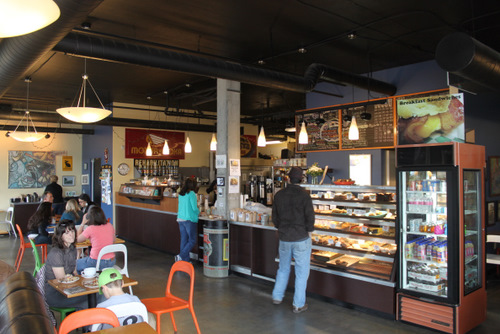
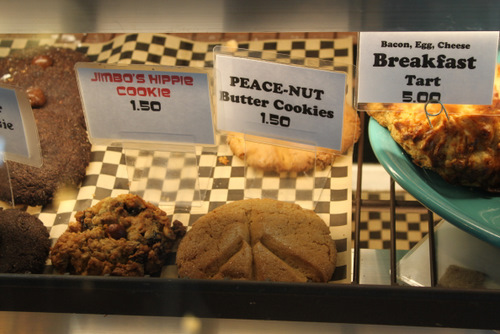
Jim & Patty’s carries on many of the traditions that started with the original Coffee People. The café has a familiar feel, with plenty of Portland “weird” thrown in for good measure. The quirkiness extends itself to the café’s famed sour cream coffee cakes, which carry names like the “Naughty Supermodel Marionberry” and “Give PEACH a Chance.”
“People still see us as Coffee People. And we basically run it as if it were a Coffee People. Somebody called us a 'post-hippie' phenomenon. We have tie-dye here and there. It's our niche.”
Roberts believes that Jim & Patty’s coffee is of a higher quality than his earlier enterprises. He says that the café’s coffee quality has improved, and he attributes this to its relationship with Stumptown, which roasts coffee for Jim & Patty’s and also trains the café’s baristas.
“The quality of coffee today at Jim & Patty's, because of Stumptown, is much better. We're brewing to much higher standards than we ever did at Coffee People.”
In addition to Stumptown coffee, Jim & Patty’s sells a coffee from Caravan that is a throwback to the 1990s (dark, with an edge to it), as well as the Black Tiger blend, which was Coffee People's most famous brew, and still roasted by the company. The high-caffeine blend (that includes Robusta beans) is anything but subtle. Roberts described the Black Tiger this way:
“It's like country music or thrasher rock. It's not Mozart, but my customers love it. There's sort of a Black Tiger subculture here that comes in and 'drinks the tiger' because they can't get it anywhere else.”
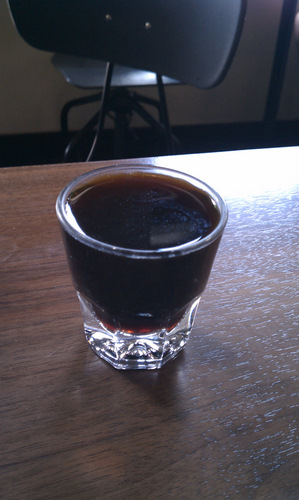
While I was there, I tried a shot of the Black Tiger. I can only say that those who drink the Black Tiger are far tougher than me. It is about the earthiest (think peat moss in a cup) coffee I have ever had. Most of the Portland cafés cringe at the thought of selling anything with Robusta in it, but not Roberts.
“We're kind of outlaws for doing it [selling the Black Tiger], but that's why we're not part of the “Third Wave.” We've always tried to have the attitude to give the customers what they want, so if they want the Black Tiger, we’ll give it to them.”
Bonding with the neighborhood through tragedy
In addition to the ups and downs that the coffee business has brought them, the Roberts have also dealt with some personal difficulties. One of the Roberts' sons, who was a barista at Jim & Patty’s, committed suicide in 2006. As a result they planned to close the shop for a while, since no one felt like working. In an effort to support the family, people from the Beaumont neighborhood came to the Roberts and told them they wanted to run the café for them while they were grieving.
“Some of the people came out to our apartment in Tigard and said ‘Jim, we'd like to run the store for you,’” Roberts told me. “They asked for the keys and did their best to run the store. People baked things at home and brought them in, made coffee and stood behind the counters. They covered the place with flowers.”
The gesture really cemented the Roberts' commitment to the neighborhood, where they now live. It sounded like they would be there for a while.
“The neighborhood has just treated us like family. We're in a great spot.”
Lessons learned
I asked Jim if there were any lessons that had stuck with him from his years at Coffee People. He brought up the challenges of trying to grow the business into a national chain.
“It's a battle between the experts and accountants trained at a university and the instinctual entrepreneurs who understand an area, and have insight into what the customers want,” he explained. “I'm not saying that the MBAs don't [understand], but Coffee People got invaded by lots of people who knew nothing about the industry.”
At one point, Coffee People hired a CEO who had run other very successful food companies. The new CEO made some decisions that seemed counterintuitive to Roberts. One particularly telling episode happened when the company hired a research firm to help decide which cities Coffee People should expand into.
“I knew we were in trouble, when after paying $25,000 for this study, we were told that Portland was number 38 on the list of cities where Coffee People could be successful. Vicksburg, Mississippi, was number 37 on the list. If you've ever been to Vicksburg [a rural town with a metro population of less than 50,000 people] you'd know that there's something wrong with that. I knew that if that was wrong, the whole thing was probably wrong.”
Although these kinds of problems eventually led to Coffee People’s downfall, Roberts does not foresee the same things happening to Stumptown.* He believes that the situations between Coffee People and Stumptown are very different.
“Stumptown is a more substantial company than Coffee People ever was. We had a lot more stores, but Duane is an international coffee leader and has created a revolution in coffee across the country.”
Easing into retirement
During the interview, Roberts announced that it was his last day at the café.
“The boss took me off the schedule,” he said. “I’m done.”
Though he is done working a regular schedule at the cafe, he said he would probably substitute from time to time.
Any other plans?
“I'm not sure. I'll think of something. I've always wanted to start some other little type of business, just for the fun of it. Starting businesses and trying to make them work is what I enjoy doing.”
When I asked Patty what she thought about his retirement, she said that Jim would still be around.
Jim nodded, knowing it was probably true. With the contented smile of someone who is happy where he is at, he said “I’m going to come down here and just enjoy drinking coffee.”
After hearing about his life in coffee, it is hard to imagine Jim Roberts doing anything but welcoming people into his café and sharing a cup of coffee with them.
*When the recent news of Stumptown’s equity sale to TSG broke, there was a fair amount of chatter around the Portland area about what would happen to one of Portland’s most beloved coffee roasters. Fans of the company’s anti-corporate, rebel-hipster ethos and high-quality coffee worried that once the new owners got hold of the company, the Stumptown experience would change. Their fears were reasonable, as the interests of fast growth and maintaining the same quality are often not aligned.