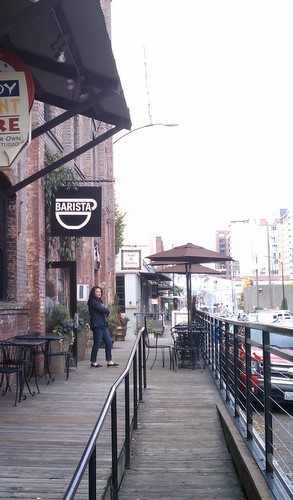
As you may have read earlier, when I went to the Pearl District’s Barista, I tried a very pricy vacuum pot of coffee. Barista is one of the trendier cafés in Portland, and it has an interesting spin to it. Instead of being aligned with a single roaster to provide its coffee, Barista selects whatever coffees it wants to, frequently rotating them. When you go, you might find that the coffee you loved so much last time isn’t even on the menu. Some might find this frustrating, but for those of you who like to try new things, Barista is right up your alley.
Barista
When I was at Barista, they had three different espressos on grind—Hair Bender (from Stumptown), Black Cat (Intelligentsia) and Apollo (Counterculture). For French press, they offered an Ethiopia Mordecofe and for the vacuum pot, an Ethiopia Sidama (Intelligentsia). So many choices! I was really tempted to try the Apollo, but I had gone there specifically to try out the vacuum pot. Therefore, Sidama it was.
Janet Morrissey wrote an article for Time this week that implied that young people are not going to drink coffee in the future because they drink Red Bull or other energy drinks instead. I disagree, and judging from the comments, so do many others. According to the article, the heavy marketing that energy drink companies have done to give energy drinks a ‘party drink’ image is a sign that coffee’s future is not bright.
There is no question that the energy drink companies have been pushing hard to reach college campuses. At PSU, there is a vehicle parked somewhere on campus at least once a week where young, good-looking people hand out free energy drinks to students. And I admit to being surprised when I read about the twenty-something PR consultant who said he didn’t drink coffee because it tastes bad (He drinks Red Bull, and he complains about the taste of coffee?).
However, if you spend much time in coffee shops, you see young people everywhere. When I worked at Starbucks in Boston, we had a large group of regulars that came over every day from a nearby high school (sometimes twice!). The cafés around PSU are jammed every day with the 18-24 year-olds that are mentioned in the article. I stopped in at the PSU library the other day and was surprised to see a new coffee bar in the lobby. This evidence leads me to believe that coffee is not doing too badly in the under-30 crowd.
If you want to make the case that this age group won’t be drinking more Folgers in the future, that’s different. After all, this is the generation that came of age during the golden era of Starbucks. Of course they’re not going to accept the taste of pre-ground or freeze-dried coffee that has been stored in a can for six months! However, predictions that young people will not be drinking coffee in the future are like predictions that bell-bottoms would never be seen again after the 1970s. They make for a good story at the time, but years later, people look back at and laugh about them. In twenty years, we will be able to look back and this one and laugh too.
[note: Portlanders will be proud to hear that Stumptown was mentioned in the article as a place where younger people do have a good coffee experience (at the Stumptown Ace Hotel in New York City)].
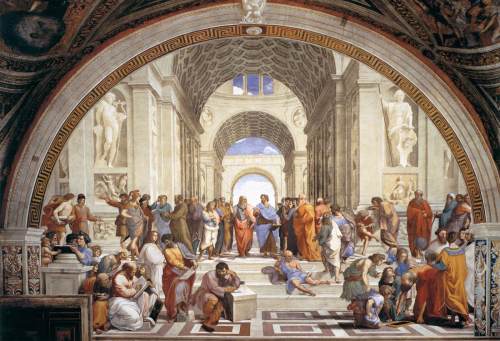
Any art or design enthusiasts reading today? Today’s post is about art and how artists include symbolism in what they create. I took a class on art history when I lived in Boston and was fascinated by the Italian Renaissance. I enjoyed learning how artists like Brunelleschi, Uccello and Rafaello (my favorite) created beautiful art while subtly placing symbols in their work. Here is Rafaello’s School of Athens:
The fresco is a celebration of knowledge and wisdom. Raphael filled the scene with many important artists and philosophers (he placed his rival Michelangelo front and center), and even slipped his self-portrait in along the right edge. (You can see a larger image if you click here, and Wikipedia has a good description of who some of the characters in the painting are here.)
Staying with the symbolism theme, I thought I’d share a little bit about what the Caffeinated PDX logo stands for. If you are a fan of art or “symbology” (the fictitious discipline that Robert Langdon studies in The Da Vinci Code), you might enjoy hearing about it. The logo is more than just a bunch of lines on a page and has at least five layers of meaning in it (though I’m not trying to say it compares to anything that the Renaissance masters have done). Hopefully, when you look at the logo from now on, you will think of what it stands for and remember that there can be a lot of meaning hidden inside simple things.
Before I describe it, though, I’d like you to study the logo for a minute and think about what you might see in it. Then when you’re done thinking, jump below to peer inside the mind of the artist.
The first meaning is all about the coffee. You can see a wisp of vapor rising above the rim of a coffee cup. This is a warm, comforting sight when you grab a cup of coffee on a cold day. You might also see that the steam looks like the profile of someone’s face, someone who could be taking a sip from the cup. Or you might see that the steam looks like a winding path. This represents wandering, something I’ve done quite a bit. In addition, the steam looks similar to a quarter note rest on a musical score written backwards, reflecting my interest in music.
Finally, if you take another look at the rim of the cup on the bottom part of the logo, you can see how it looks like a subtle smile. This represents the little pick-me-up that people get from their coffee or, hopefully, from reading this blog ;). That’s our goal here at Caffeinated PDX—to bring you that subtle smile every time you come by for a visit.
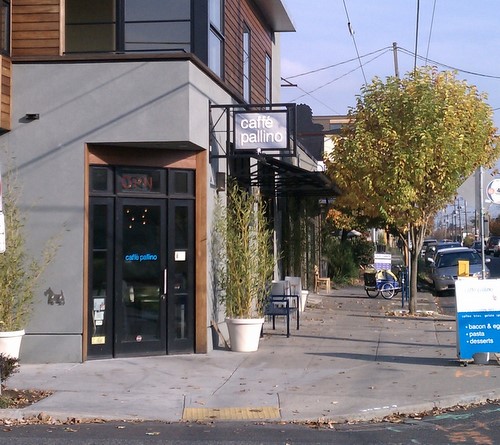
Caffè Pallino, on SE Division, is not a bad place to go if you´re looking for a place to get together and meet for breakfast or lunch. I went there on the recommendation of another café owner in Southeast PDX. When I walked in, the barista at the counter greeted me pleasantly. She didn’t have too much to say about the coffee, though, except that it was from Caffè Umbria. The double espresso she made was drinkable.
Pallino is the spot
The café space is very open, with several large, south-facing windows. It looked like they would open up onto the street during the summertime. I enjoyed the light, airy feel of the café that the windows provided. Sunlight happened to be pouring in that day, a rare treat in Portland for this time of year. The café has two large common tables, a couple couches and some smaller tables along each end of the café. I saw several groups come in and use the large tables while I was there.
Going to business school, you get to learn all kinds of fun stuff, especially if you haven’t spent much time in the corporate world. Our first term of the MIM program we took marketing from Brian McCarthy, a former GM of marketing at Microsoft. His class was lots of fun and very informative, and it really opened my eyes to how companies try to reach customers. The biggest challenge that all companies have is trying to get people to try their products. Then they try to create some type of emotional bond with their customer. Most people are creatures of habit, and once they find something they like, it is hard to get them to try new things. You could say that marketing is the science (or art) of overcoming that resistance to change.
Ever since taking Brian’s class, I pay more attention to ads and commercials. I try to figure out what they’re trying to communicate. For example, I will see a commercial for Chevrolet pickups and try to dissect it. What is it trying to say? Chevy Trucks (a more “manly” word than pickups) are tough, reliable and American. The message goes beyond the products being sold and moves into the realm of emotions and values.
One of the projects we had to do for class was to develop a marketing plan for some type of product. We could either choose to market our own business idea or we could take some company’s product that we liked and pick a country outside the US in which to market it. I chose to write a marketing plan for Illy coffee in China, probably because I was drinking a lot of Illy coffee at Park Avenue Café at the time.
One of the things I came across when I was creating the marketing plan was the following commercial (it’s much better if you play it with something that has good speakers and turn up the sound):
Elegance. Style. Art. Beauty. The finer things in life. These words describe what comes to mind when I watch that commercial. I was captivated when I saw it. The music (Atlantico by Roberto Cacciapaglia) was dramatic, the images were beautiful and graceful and the tagline, La bellezza ha un gusto (literally “beauty has a taste”), captured the spirit of both Italy and the company. Italians care deeply about the quality of the food and drink they consume, and their companies are well-known for their beautiful design (think Ferrari, Ducati, Gucci).
In the marketing plan, I wrote that the commercial would resonate in China too. The people in both countries have a strong appreciation for beauty. Italy and China are also the home of two of the world’s most important ancient civilizations and if done right, a campaign of “East meets West” over a cup of Illy could be very effective.
One question about the commercial is whether it ended up selling more coffee or not. I have no idea, but at the very least it provided me with some entertainment for a while. Two years later, I still haven’t forgotten about it, so Illy was effective at reaching at least one customer. My question is, does it capture your attention like it did mine?
 Barista