A couple pics from our recent jaunt to San Francisco:
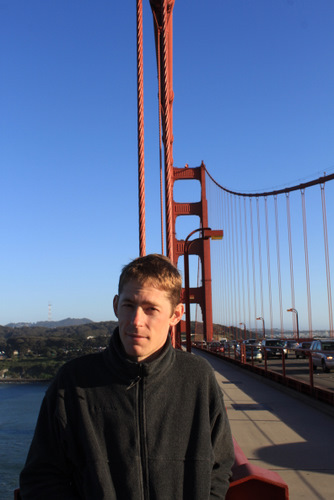 The Golden Gate Bridge, a must-see for first-time vistors
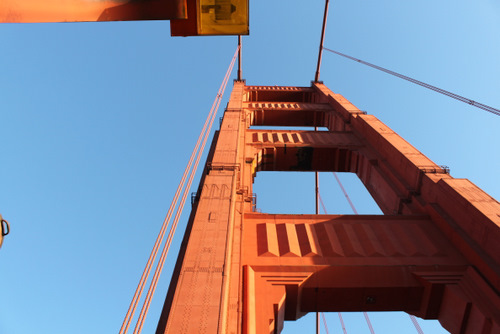 Still looks great after 78 years
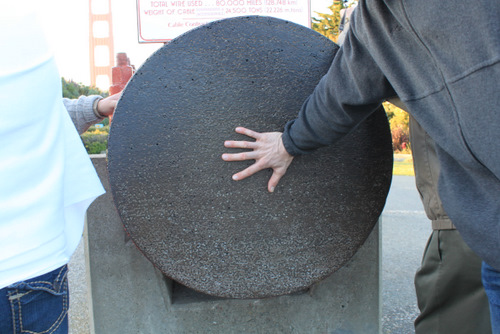 That's a big cable
Your Custom Text Here
A couple pics from our recent jaunt to San Francisco:
The Golden Gate Bridge, a must-see for first-time vistorsStill looks great after 78 yearsThat's a big cable
This weather, in the present-day vernacular, is getting “ridiculous.” It’s May. I don’t know about you, but I’m getting tired of the cold. So far this year, we’ve been teased with the occasional nice day, but our expectant hearts are then dashed to the ground by the next untimely cold front. It’s time for some heat.
Speaking of heat, that’s what I found today when I tried a “Toddy Diablo.”
The time: 3:00pm.
The place: First Cup, on Woodstock.
If you were to have a “throw down” between the coffee shops on Woodstock, First Cup would probably win. The shop is pretty small, so it gets a little cramped sometimes. It is a place for Reedies to hang out and there are often lots of students coming in and out. The atmosphere is welcoming, if you can find a seat. They serve Stumptown coffee, with Hair Bender available every day as one of the two brewed coffees and also as the espresso.
Since summer is supposedly approaching, cafés are pulling out their warm-weather drinks more these days, including cold-brewed coffee. Today, First Cup was advertising a “Toddy Diablo,” a “cold-pressed coffee with a house-made chile syrup” (toddy is the term for cold-brewed coffee that cool Portland cafés use—there’s no whisky in it). A couple months ago, I tried my first cold-brew coffee at Case Study. That was a memorable first time, and I have been a fan of the cold brew ever since.
I asked the barista what she thought of the Diablo. A sly grin came to her face when she told me, as if it were a secret between us, that the drink was really good. Devilishly good, perhaps?
She described it as spicy, not like habanero peppers, but more of a smoky, slow burn. Would I like to try it?
Yes, please.
The first sip of the drink was revealing—not quite like I expected. Instead of raw heat, the coffee had a hint of sweetness. Sweet and then hot. The barista later told me that the sugar gives the spice something to hold onto and is better than using only pepper in the syrup. As you swallow, the pepper warms your mouth, with the heat slowly moving to the back of your throat and downward, until you feel a slow simmering in your chest. The aftertaste is a touch smoky, like smoldering wood chips. It reminds you of drinking coffee prepared over a campfire.
Like my first iced coffee, the Diablo was another memorable first time. It’s not something you would drink every day, but for those days when you are looking for something different, when you need something to spice up your coffee palate and shake off the erratic Portland spring weather, try the Diablo at First Cup. If you dare.
Another story from San Francisco:
Anthony Salas, a barista at Paper Tiger Coffee in Vancouver, suggested that we try out Sightglass Coffee while we were in San Francisco. Always up for trying new places, we followed his recommendation. It turned out that finding the café was as memorable as the café itself.
Sightglass Coffee is located on Seventh Street, close the heart of downtown San Francisco. After lunch at the wharf, we hopped onto the cable car and rode it over the hill to Hallidie Plaza (For the record, the cable car is overrated—not much more than tourist transportation. I would estimate that 95% of the people on the car were tourists, and the other 5% were the driver and the ticket-taker. Call me a cynic, but it was not the “San Francisco treat” that you have seen on television). From the plaza, we walked down Market Street and turned onto Sixth Street. We could have walked one more block to Seventh , but I wanted to get off of Market because it was loud from all the traffic. Our chosen route made for a more interesting story, though at the time it was a little unsettling.
To give you a little background, when traveling, I do my best to not look like a tourist. Granted, this is not always possible, but I try to not saunter around gaping at tourist attractions, snapping lots of photos and being more conspicuous than necessary. I try to act like I know where I am going, and I do my best to avoid using maps in public. Tourists can be targets for mischievous or malevolent people, so it’s best to not look like one.
We probably should have done a little research about this part of the city before we went, because it would have been good to know its reputation. On Sixth Street, it was pretty much impossible to not look like a tourist. Theoretically, it could have been the safest part of San Francisco, but the neighborhood looked like it was going through a rough time. There were lots of shops that looked run down, with paint peeling off the walls, as well as many empty storefronts covered with old posters and graffiti. The shops that were open included several pawn shops and convenience stores. Groups of young black men stood around, crowding the sidewalk and watching us as we went by. It reminded me of walking around Datong, China, where the local people stared at the unfamiliar faces (us) passing by them. Even worse, I had a camera around my neck, flashing “TOURIST!” in big bold letters to everyone on the street.
I felt out of place, and asked myself if I was nervous because we appeared to be the only white people there, or if the area just gave off the impression that it was unfriendly. It was probably some of both. It can be unsettling when you visit a place where you stand out so much.
That said, I don’t think my uneasiness was much different than what people from outside Portland feel when they visit downtown and have to pass through the groups of homeless people crowding the sidewalk. Walking around downtown Portland doesn’t bother me anymore, but I have spent a lot of time there. Sixth Street in San Francisco was completely new to me.
To add to my unease, one of the things we saw as we were walking was likely a drug handoff. I could be mistaken, but seeing two men approach each other on the sidewalk and discretely pass a small paper bag between them without saying anything seemed a little suspicious. I commented to my wife that it didn’t look like they were sharing doughnuts. She agreed. We kept walking, pretending not to notice, or at least to not care.
The most memorable incident of our side trip took place a couple blocks later. As we came to the corner, a tall black man dressed in a red hat and a blue and white sweat suit looked at us in disapproval. He was talking to a group of men, and as we approached, he stepped out directly in front of us.
“. . .and someone like this honkey,” he said, glowering at me.
“Oh, sh--,” I thought.
My heart jumped when he said that, though I tried to not show any fear. We stepped around him to the left, hoping that he wouldn’t try to stop us. If he had, I’m not sure how I would have reacted. I wasn’t looking for a fight, just a coffee shop. Fortunately, the man made no other moves to block us—he had already made it clear enough that we weren’t welcome in his neighborhood. We kept walking, glad to soon reach our destination.
Looking back on our misadventure, I doubt we were ever in any real danger. We were uncomfortable, but no harm came of it. After all, the man made no physical contact with us. All he did was call me a honkey, which is actually kind of funny. I haven’t been called that since the days when I used to play a lot of basketball. There was always lots of creative things said in the heat of the games.
All in all, our quick trip to Sightglass was a memorable one. We found some pretty good coffee and we came away with a story to tell.
What is it that makes a café a “local place,” or even what I would call a “neighborhood institution?” In my previous post about Xpression Coffeehouse, I wrote about how the owners want to make their café a place where the neighborhood gets together. But how does a café reach that goal? There may not be a single answer to that question, but I do know that some places are successful while others are not.
Last week, I visited the original Caffe Trieste in San Francisco, and it is a place that definitely has “it.” The café is the proverbial place “where everybody knows your name.” Although no one knew my name when I was in there, I was confident that after a few visits, many of them would.
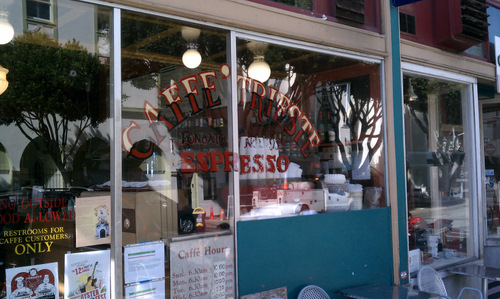
Having great coffee is not the only way to become a neighborhood café. The first day I went to Trieste, in fact, I thought my espresso was barely drinkable. If I were going to base my experience solely on the coffee, I would not have gone back the second time. However, my pastry was excellent (it tasted a lot like a chocolate chip cookie) and the environment was fun, interesting, and full of character and quirk. I wanted to go back.
The other day, I went searching for a different café in Southwest Portland. I had a couple hours to kill before I picked my daughter up at preschool, and although there are a couple cafés fairly close to the school, I have not been overly excited by either of them. I knew there was another coffee shop in the area I wanted to try out, so I went looking for it. It wasn’t easy to find, though, and I was about to give up when I glanced over and saw the sign for Xpression Coffeehouse to my right. It turned out to be a nice discovery.
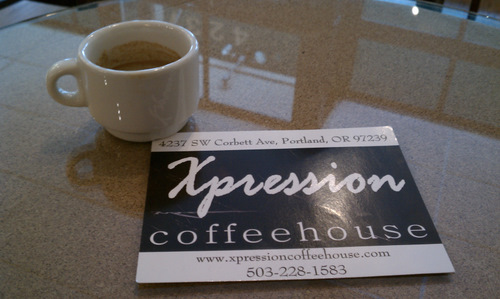
As I entered the café, the first thing I noticed was that it felt very welcoming. Soft jazz music was playing and a strong scent of coffee filled the air. The barista greeted me as I came up to the counter. She was working on a drink for the person in front of me and said she would be right with me. I waited, listening to the music that was playing, reading the information screen located behind the register. I was surprised to read that the music was original and composed specifically for the café.
“That’s one way to get around the music-industrial complex,” I thought, recalling an article I had recently read discussing coffee shops and music copyright issues.