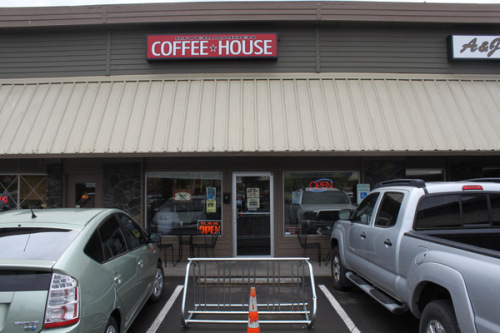
Clover-brewing at River Maiden Coffee, Vantucky, Washington

My recent search for new and improved coffee experiences took me to River Maiden Coffee in Vancouver, Washington. River Maiden is a coffee shop that plays up Vancouver’s “second city” status with its “Vantucky Strikes Back” logo on cups and shirts. It also has “The Couve Abides” cups and shirts that fans of The Big Lebowski would appreciate.

River Maiden Coffee House

In addition to having an appreciation of pop culture, River Maiden is also one of very few independent (i.e., non-Starbucks) coffee shops in the world to have the Clover brewing machine.

The Clover is a machine that combines the brewing principles of a French press and a vacuum pot. It was designed by a couple of coffee-loving Stanford engineers, who proceeded to build a company around it. Starbucks executives were so impressed by the machine that they decided to buy the whole company. These days, if you want to try some Clover coffee, you either have to go to Starbucks or find one of the indies that had one before Starbucks bought them all. [An interesting side note: When the Clovers first came out, Stumptown had several, but then sold them all when managers heard Starbucks had bought Clover. The rumor was that Stumptown did not want to have any dealings with “corporate” Starbucks.]

Read More

#Trust30 - Day 9 - Too scary?

[To find out why I am writing all these #Trust30 posts, click here]

Today's Quote:

The other terror that scares us from self-trust is our consistency; a reverence for our past act or word, because the eyes of others have no other data for computing our orbit than our past acts, and we are loath to disappoint them. - Ralph Waldo Emerson

And the Prompt:

Emerson says: “Always do what you are afraid to do.” What is ‘too scary’ to write about? Try doing it now. – Mary Jaksch

Hmm. It’s one thing to answer a question like this in private, with your best friend or confidant, but when you start expecting me to write about something like that in this space, I begin to question my wisdom in accepting this writing challenge.

Some of the things that are “too scary” to write about are things best kept in confidence. At least they are things that I am not ready to share in a public forum. However, I will try to give you something, because you have been kind enough to come here to read this.

*thinking*

It took a while, but after staring at this screen until the white page permanently stained my retinae, I found my topic: love.

Read More

#Trust30 - Day 8 - A look back

[To find out why I am writing all these #Trust30 posts, click here]

The prompt:

What would you say to the person you were five years ago? What will you say to the person you’ll be in five years? - Corbett Barr

Before I start answering, could I talk to the person from 10 or 15 years ago too?

I try to not look back on things too much, because looking back like that can fill your mind with too many ifs, as in “if only I had….” You can see all of the mistakes you made and what you could have done differently. Five years ago, I was living in Boston, trying to figure out my new job requirements at Starbucks. It was the first time I had worked in customer service, and it opened my eyes about service jobs. Fortunately, I had a great group of people to work with and it was a great experience (everyone should have to work in food service at some point in their lives. It would give us all a lesson on how to treat others. For the most part, the customers were great, but there were those who—to be nice—weren’t. They had forgotten that baristas (or waiters, waitresses, bartenders, etc.) are there to serve them, not be their servants. It is a huge difference).

There are definitely a few things I would say to that me. I would tell that other self that when life throws you a curve, don’t panic. Don’t get in any rush to change what you are doing. You can figure it out. Go after your dreams with everything you have and ask others for help when you need it, because people are willing to help you, if they know you want it. If you don’t ask, they won’t know.

And to the person I am in five years:

I persevered, and succeeded.

[Question: Do you think it is valuable to look back at your life in this way? Does it help you figure out where you are going today?]

#Trust30 - Day 7 - Big goals

[To find out why I am writing all these #Trust30 posts, click here]

Here's the prompt, from Matt Cheuvront:

“Next to Resistance, rational thought is the artist or entrepreneurs worst enemy. Bad things happen when we employ rational thought, because rational thought comes from the ego. Instead, we want to work from the Self, that is, from instinct and intuition, from the unconscious. A child has no trouble believing the unbelievable, nor does the genius or the madman. Its only you and I, with our big brains and our tiny hearts, who doubt and overthink and hesitate.” - Steven Pressfield, Do the Work

The idea of “being realistic” holds all of us back. From starting a business or quitting a job to dating someone who may not be our type or moving to a new place – getting “real” often means putting your dreams on hold.

Today, let’s take a step away from rational thought and dare to be bold. What’s one thing you’ve always wanted to accomplish but have been afraid to pursue? Write it down. Also write down the obstacles in your way of reaching your goal. Finally, write down a tangible plan to overcome each obstacle.

The only thing left is to, you know, actually go make it happen. What are you waiting for?

There were lots of things I could have chosen, but I only have time to write about one.

Read More

2011 World Barista Championship - Alejandro Mendez, Campeón!

This past weekend, the 2011 World Barista Championships took place in Bogotá, Colombia. For the first time ever, a competitor from a coffee-growing country won first place. El Salvador’s Alejandro Mendez won the competition, beating out the US’ Pete Licata, who finished second after having the highest score in the semi-finals.

Mendez put on an impressive display of coffee knowledge, enthusiasm and creativity. For his signature beverage, Mendez combined flavors from all parts of the coffee plant. He made an infusion from dried coffee flowers (that he had collected himself), one from the mucilage (the fruit pulp), another from the cascara (dried skin from the coffee fruit) and combined all of them with an espresso made from the roasted coffee beans. His goal was to give the judges the entire flavor of the coffee tree. The commentators (yes, the broadcast has commentators, much like golf) thought that this was the first time anyone had combined all of these elements into a beverage (you can see the video here. Mendez’ finals performance starts at about 1:30 into the video and lasts 15 minutes).

If you watch the video of the performance, you will notice Mendez’ deep knowledge of the coffee, his attention to detail and his willingness to try unconventional techniques. Mendez tells the story of how he tested his espresso at the same altitude as Bogota and found that 14 days post-roast was the best day to use it for the competition. He also made a very bold move when he had the judges strain off the crema from the espressos before they drank them. Personally, I question whether this should be allowed, because the crema is an integral part of the espresso experience. However, the judges allowed it, and it certainly helped to make his performance memorable.

Mendez’ win is more impressive because he was competing in English, which did not appear to be his first language. Imagine if the other competitors had to learn the language of the host country in order to compete—that would make it much more challenging. That is what the competitors from non-English-speaking countries have had to do for years.

The 2011 competition was the first time the championships have been held in a coffee-growing country (excluding the small amount of coffee that is grown in Hawaii), which was a big deal for the coffee industry. One of the biggest social issues involved with coffee production/consumption is the fact that for years, coffee producers in developing countries have not benefited from the increase in value of coffee as it was roasted, brewed and sold to customers at high markups.

Coffee-importing countries placed tariffs and quotas on roasted coffee in order to protect their own roasters, which hampered the development of a roasting industry in coffee-growing regions. The system led to much of the value of the coffee crop leaving poorer countries and moving to richer countries.

Today, the specialty coffee industry is trying to make the distribution of the value of the coffee more equitable, and by holding the barista championship in Colombia, the SCAA/SCAE has raised awareness about coffee production and demonstrated its respect for the coffee-growing countries. Hopefully, it will not be another decade before the competition is held in one of these countries, nor will it be surprising when a barista from El Salvador, Colombia, Rwanda or any other coffee producer brings home the top prize.

Congratulations to Alejandro Mendez, the 2011 World Barista Champion.

[If you want  a more complete 2011 WBC wrap-up, complete with lots of photos, visit Barista Magazine’s blog here.]